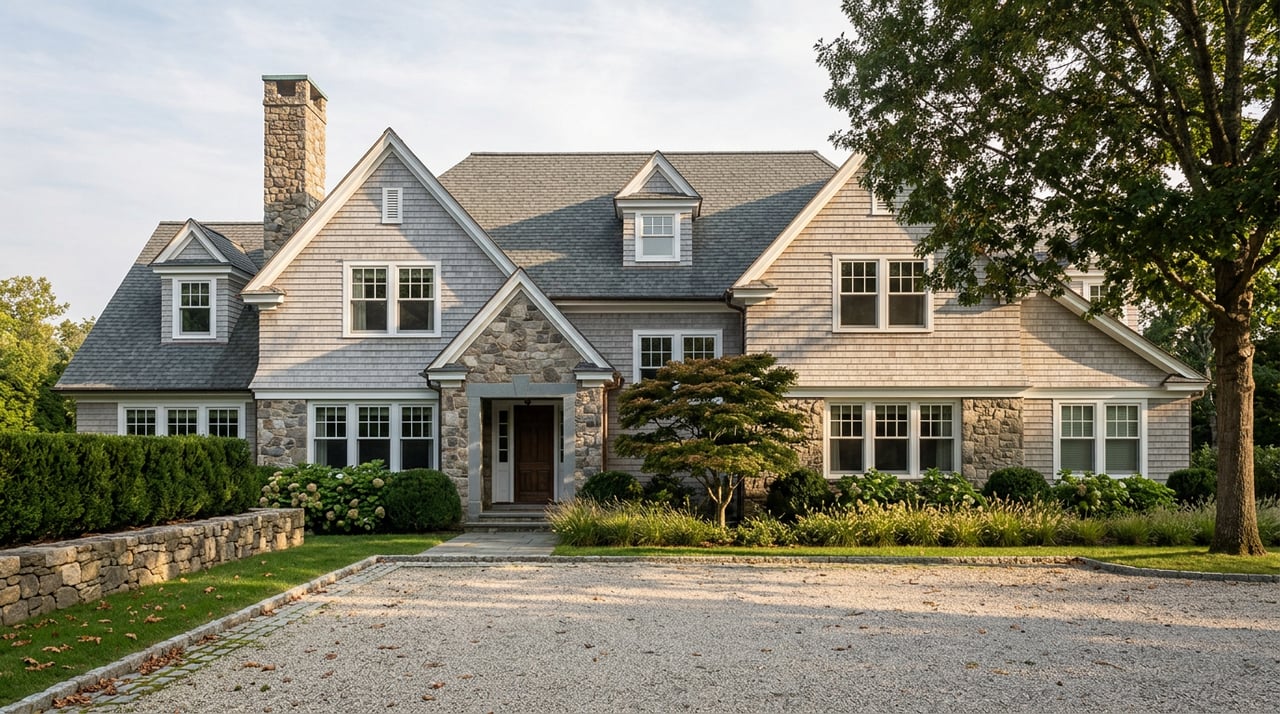
The Median Price for Riverside Doesn't Exist. Two Different Ones Do.
September 24, 2026
September 24, 2026
"The whole downtown corridor is a number one priority for our Association in terms of this project."
That's Jeff Hadzima, a member of the Riverside Neighborhood Association, talking to Connecticut Public in late August about a plan to put 13 townhomes on a mostly forgotten lot next to a McDonald's on East Putnam Avenue. It sounds like a small story about a small parcel. It's actually the first real evidence in years that Riverside's oldest structural fact, a highway that splits the neighborhood into two very different markets, might finally be starting to move.
If you've been comparing Greenwich neighborhoods on a portal, you've already seen a number for Riverside. The problem is that number is doing more work than it should.
Pull up three different sources this month and you'll get three different answers for what a home in Riverside costs. Redfin's Eastern Greenwich neighborhood page puts the median sale price at $3.4 million over the three months ending July 2026, up 19.4 percent year over year, with homes selling in about 15 days. Zillow's own home value index for Riverside, updated July 31, 2026, lands at $2.47 million, up 14.5 percent over the past year. A separate Redfin page, drawn from a slightly different geographic boundary, shows a median closer to $2.5 million, actually down 4.4 percent year over year, with homes taking 17 days to sell.
None of these sources are wrong. They're measuring different slices of the same small peninsula, and that's precisely the point. Riverside is roughly two square miles with about 8,400 residents, and within that footprint sits one of the widest price ranges of any single-name neighborhood in Greenwich. Any median you pull is an average of two markets that don't behave alike, and the line between them is a highway.
Interstate 95 runs through Riverside almost like a property line the town never had to draw on purpose. South of it, the neighborhood narrows into a peninsula toward Long Island Sound, and most of that land falls under RA-1 zoning: one-acre minimum lots of 43,560 square feet, with a floor area ratio of .135 that caps a house at roughly 5,881 square feet. Some of the private shorefront associations down there are informally nicknamed "Little Belle Haven" by agents, a shorthand for the gated, guarded feel of the priciest corner of the neighborhood.
North of the highway is a different neighborhood in almost every way except the name. This stretch, often called North Mianus, has historically had smaller lots, a mostly R-7 zoning pattern, and none of the RA-1 one-acre floor. It also has the closest thing Riverside has to a commercial strip: Riverside Commons on Putnam Avenue, home to a grocery store, a post office, a CVS, and a Chipotle. There's no village green, no walkable restaurant row, none of the downtown feel you'd find a few minutes away in Old Greenwich or Cos Cob.
That absence of a center is not incidental to the price gap. It's a large part of what causes it. A zoning-based sales analysis of Riverside transactions found the lowest sale in an R-7 zone at $705,000 against a high of $7.8 million in an RA-1 zone in the same year, a tenfold spread inside one neighborhood boundary. Prices have moved a great deal since then, but the zoning framework that produces that spread hasn't changed at all. That's the mechanism a portal median can never show you.
| South of I-95 | North of I-95 (North Mianus corridor) | |
|---|---|---|
| Zoning | RA-1, one-acre minimum lots | Predominantly R-7, denser lots |
| Max home size under current FAR | About 5,881 sq. ft. on a one-acre lot | Smaller by-right allowances |
| What's within walking distance | Riverside Yacht Club, private shorefront associations | Riverside Commons: grocery, CVS, Chipotle, post office |
| Historic pricing pattern | Waterfront parcels reaching well into eight figures | Entry-level sales historically under $1 million |
Which brings us back to 1205 East Putnam Avenue. The parcel currently sits with an unused two-family home on it, next to a McDonald's, in the part of Riverside that has never had much of a downtown to speak of. It's also seen this movie before. A developer previously tried to bring an apartment complex to the site. Another tried for a Shake Shack. Both failed to win zoning approval.
The current proposal is different in character. Developer Ed Zislis is pitching 13 three-story townhomes, with market-rate units expected to sell between $1.8 million and $2.4 million. That's a meaningfully different price band than anything the R-7 side of Riverside has typically produced, and it's coming with the neighborhood's own blessing rather than against it. Susan Foster, another Riverside Neighborhood Association member, told Connecticut Public she supports the plan specifically because "it will be residential and not, say, a fast-food restaurant open from morning till night." Planning and Zoning Commission Chair Margarita Alban has asked for a traffic study before the commission moves further, noting a practical concern about the site's exit onto a road with a constructed median, where "people can only turn in one direction." The developers expect to bring a final proposal to the commission by the end of 2026.
A 13-unit townhome project is not, on its own, going to erase a tenfold zoning-driven price gap. But it matters for a reason that has nothing to do with unit count and everything to do with who's asking for it.
This isn't a developer parachuting into a neighborhood that doesn't want them. It's the Riverside Neighborhood Association itself pushing for a project because it fits a goal they've stated plainly: giving the north side of the neighborhood something like a cohesive downtown corridor. That alignment, neighbors wanting the investment, a town commission willing to entertain it, a developer pricing units well above what the corridor has historically supported, is a different setup than the fast-food and apartment proposals that came before and failed. Incentives are pointed the same direction for the first time in a while.
If the project is approved and delivers units in the $1.8 million to $2.4 million range, it resets what "new construction near the highway, on the north side" is worth, before a single unit closes. That's a different kind of signal than a median price ticking up or down. It's a floor being tested in a part of the neighborhood that has never really had one.
It isn't the only capital moving toward that side of Riverside. The Riverside School renovation, a separate project on the same side of the highway, has already had $2 million approved for architecture and engineering work, and the First Selectman's proposed capital plan has since earmarked $43 million for construction, with funding now targeted for the fiscal year beginning July 2028. That construction timeline has already slipped once and the funding still has to clear the town's budget process, so treat it as a plan in motion rather than a settled fact. But taken together with the East Putnam Avenue proposal, it's two separate signs of civic and private capital pointing toward the same underserved stretch of the neighborhood at the same time.
If your search has been anchored to the number you saw on a portal, a few questions are worth asking before you compare Riverside to any other town.
Is North Mianus considered part of Riverside? Yes. It's the section of Riverside north of Interstate 95, sometimes referred to by its own name, North Mianus, but it falls within the same neighborhood boundary as the waterfront section to the south.
Will the East Putnam Avenue townhomes close the price gap between north and south Riverside? Not on their own, and not quickly. Thirteen units priced between $1.8 million and $2.4 million are a meaningful data point for the north side, but the RA-1 zoning that keeps the south side expensive hasn't changed and isn't part of this proposal.
When will the project go before the Planning and Zoning Commission? As of late August 2026, the developers expected to bring a final proposal to the commission by the end of the year, pending completion of the requested traffic study.
If you're weighing a home on either side of that highway, the sub-area you choose matters as much as the number you saw when you started looking. Brid Mortamais has spent years inside Greenwich's zoning lines, not just its listings. Let's connect and schedule a personalized consultation before you compare Riverside to anywhere else.
Stay up to date on the latest real estate trends.
Brid is a full-time agent with a deep understanding of the local market and provides exceptional service for each of her clients whether they are renting, buying, or selling. She handles every aspect of each real estate transaction, guaranteeing her buyers and sellers the highest level of honesty, attention, and discretion.