The Cos Cob Discount Is Real. The Negotiating Room Isn't.
August 20, 2026
August 20, 2026
Anyone comparing home prices across Greenwich notices the gap fast. Cos Cob costs meaningfully less than Old Greenwich or Riverside, despite sharing the same school district, the same property tax structure, and the same Metro-North line into Manhattan. The instinct that follows is almost automatic: if the underlying asset is this similar, there should be room to negotiate the difference down further. Wait a listing out. Come in under ask. Let the neighborhood's lower price ceiling do some of the work for you.
That instinct is wrong, and the data explains exactly why.
Cos Cob's median sale price was sitting around $2.29 million in the first quarter of this year, a figure that comes in well below the town-wide single-family median of $3,602,000 that the Greenwich Association of REALTORS® reported for July 2026, itself up 2.49 percent from July 2025. Old Greenwich, the other walkable village most buyers cross-shop against Cos Cob, was posting a median north of $4 million as of the start of the year. On paper, that spread looks like a straightforward value play: same town, same services, lower entry point.
But price is only half the story a buyer needs. The other half is speed, and on that measure Cos Cob and Old Greenwich have been moving in lockstep, not in opposite directions. Earlier this year, homes in Cos Cob were averaging about 9 days on market before going under contract, closing near or slightly above list price, with roughly a month and a half of inventory on the ground at any given time. Old Greenwich was tracking almost identically, with both villages sitting under 40 days on market and sale prices running above 103 percent of list. The town-wide figures the Greenwich Association of REALTORS® published in August confirm the pattern hasn't reversed since: average days on market across Greenwich fell to 36 in July 2026, a 28 percent drop from July 2025, even as new listings increased. Compare any of that to the town's slower corners, where homes north of the Merritt Parkway have historically taken 105 to 120 days to sell and closed below 97 percent of asking. Those neighborhoods carry negotiating room built into the pace of the market itself. Cos Cob does not.
The reason the price gap exists at all has nothing to do with quality and everything to do with what a buyer is actually purchasing.
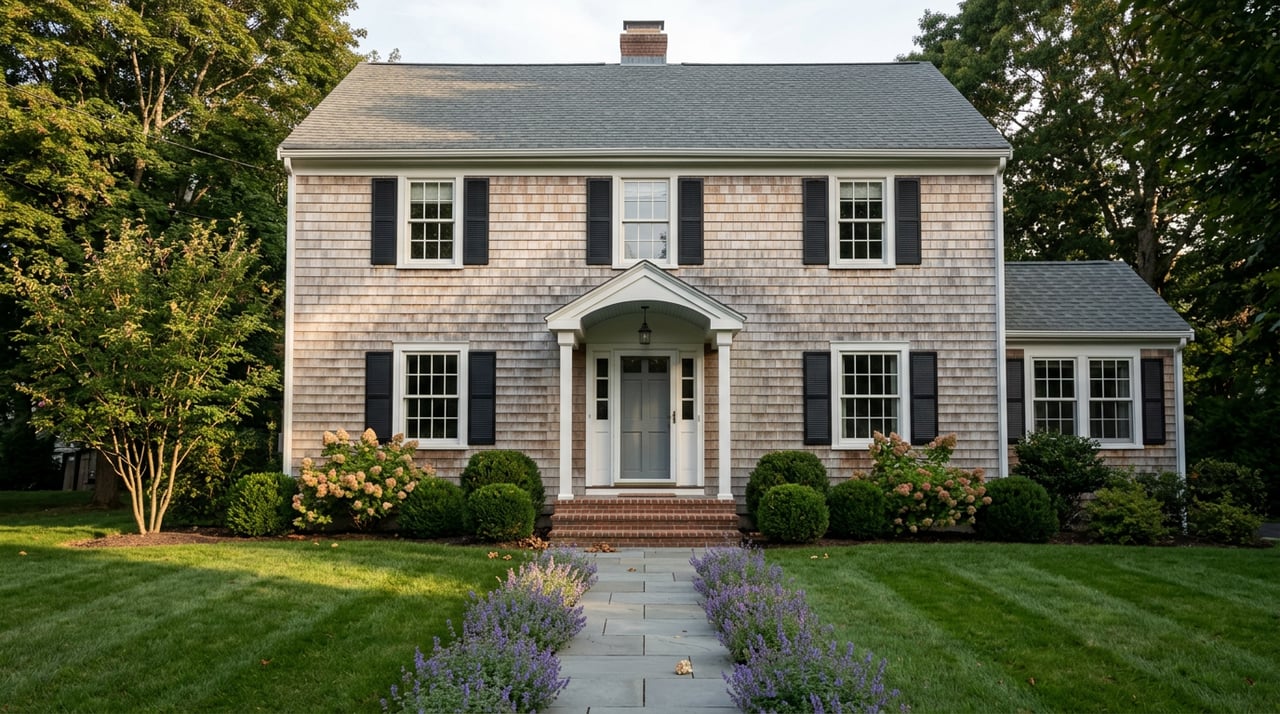
A budget of roughly $2.2 to $2.5 million in Cos Cob typically buys a 3,000 to 4,000 square foot colonial with a real yard, within walking distance of the train station. The same budget in Riverside buys a smaller house with more prestige attached to the address. In New Canaan, it buys more land and a longer commute. None of these are better or worse trades in absolute terms. They're different bets on what matters more: usable square footage and a short walk to the platform, waterfront proximity and village polish, or acreage and privacy at the cost of drive time.
| Budget: ~$2.2M–$2.5M | Cos Cob | Riverside | New Canaan |
|---|---|---|---|
| What it typically buys | 3,000–4,000 sq ft colonial, real yard | Smaller house, higher-prestige address | More land, longer commute |
| Commute character | 45–50 min express to Grand Central | Similar Metro-North access | Branch-line service, often a transfer |
| Trade-off | Density in exchange for usable house and walkability | Prestige in exchange for square footage | Privacy and acreage in exchange for time |
Cos Cob's density, close to 6,500 residents packed into under three square miles, gives it a walkable, lived-in feel that a four-acre backcountry parcel simply cannot replicate. That density is also precisely what keeps per-square-foot prices below Old Greenwich, where waterfront access commands its own premium. The gap between the two neighborhoods isn't a discount on the same product. It's the market pricing two different products that happen to share a zip code.
Here is the part that changes how a serious buyer should approach Cos Cob: the price gap to Old Greenwich and Riverside is not an invitation to negotiate. It's a countdown.
At roughly 9 days on market and about 101 percent of list price, Cos Cob offers almost no window between a listing going live and an accepted offer. This past weekend, a six-bedroom colonial on Orchard Street held its first open house within days of hitting the market, the kind of quick turnaround that has become routine here rather than notable. Buyers who show up planning to take a week to think, get a second opinion, or float a lower number are not competing against sellers. They're competing against other buyers who already have financing lined up and are ready to write full price the same week the listing appears.
That is the actual mechanism behind the discount. It isn't that Cos Cob homes sell for less because they're worth less. It's that the only buyers who capture the lower entry point are the ones who treat speed as the price of admission. Everyone else ends up paying Old Greenwich money for a Cos Cob house anyway, because by the time they've made a decision, the property that would have made the math work has already closed.
Two buyer profiles have shown up consistently in Cos Cob this year. The first is the New York commuter with young children who wants a usable house rather than a renovation project, and who values a street where neighbors are close enough to wave to over a gated four-acre setback. The second is the empty nester leaving a backcountry estate, trading acreage and privacy for the walkability and train access that a larger parcel structurally cannot offer.
Both groups are drawn to the same practical anchors: Cos Cob School as the neighborhood's elementary hub, Mianus River Park for open space without a car, and a Metro-North station on the New Haven Line that puts express trains into Grand Central in roughly 45 to 50 minutes during peak hours, with local service closer to 55 to 60 minutes. For drivers, I-95's Exit 4 and a Merritt Parkway on-ramp five minutes away make the neighborhood workable even on days the train isn't the plan, and a 15-minute off-peak drive to Stamford has become more relevant as a growing number of employers relocate offices there from Manhattan.
One detail worth confirming before closing: parking at the Cos Cob station is resident-only during peak hours and requires a Greenwich resident permit. It's a small logistical point, but it's exactly the kind of thing that catches a first-time Greenwich buyer off guard after the excitement of closing wears off.
Greenwich as a whole tends to follow a seasonal rhythm, with activity typically building through spring and summer before tapering in late fall and winter. That pattern gives buyers a rough sense of when competition eases town-wide. But town-wide active single-family inventory was down 18.7 percent year over year at the end of July 2026, the tightest supply picture the market has shown in some time, and Cos Cob's buyer pool has stayed motivated enough that the neighborhood hasn't been following the slow-season script the way some other parts of town do.
If Cos Cob is genuinely on your list, a few things matter more here than in a market with room to maneuver:
Does the Cos Cob discount ever widen enough to negotiate? Historically, the wider negotiating room in Greenwich has shown up in the slower-moving corners of town, not in Cos Cob or Old Greenwich, both of which have consistently closed near or above asking. If a widening gap does appear, it tends to show up briefly during the town's slower late-fall and winter stretch, not as a permanent feature of the neighborhood.
Is Cos Cob a good fit if I want investment upside rather than just a place to live? The neighborhood's appeal rests on the same fundamentals that support its speed: Greenwich schools, direct Metro-North access, and a walkable center that a lower price point doesn't usually buy elsewhere in town. That combination has kept demand steady rather than speculative, which tends to favor buyers planning to stay for years over those looking for a quick flip.
If you're weighing Cos Cob against Riverside, Old Greenwich, or a backcountry estate and want to understand what your specific budget actually buys in each, that's exactly the kind of comparison worth working through before you write an offer, not after. Reach out to Brid Mortamais to schedule a personalized consultation and get a clear read on where your number fits in today's market.
Stay up to date on the latest real estate trends.
Brid is a full-time agent with a deep understanding of the local market and provides exceptional service for each of her clients whether they are renting, buying, or selling. She handles every aspect of each real estate transaction, guaranteeing her buyers and sellers the highest level of honesty, attention, and discretion.