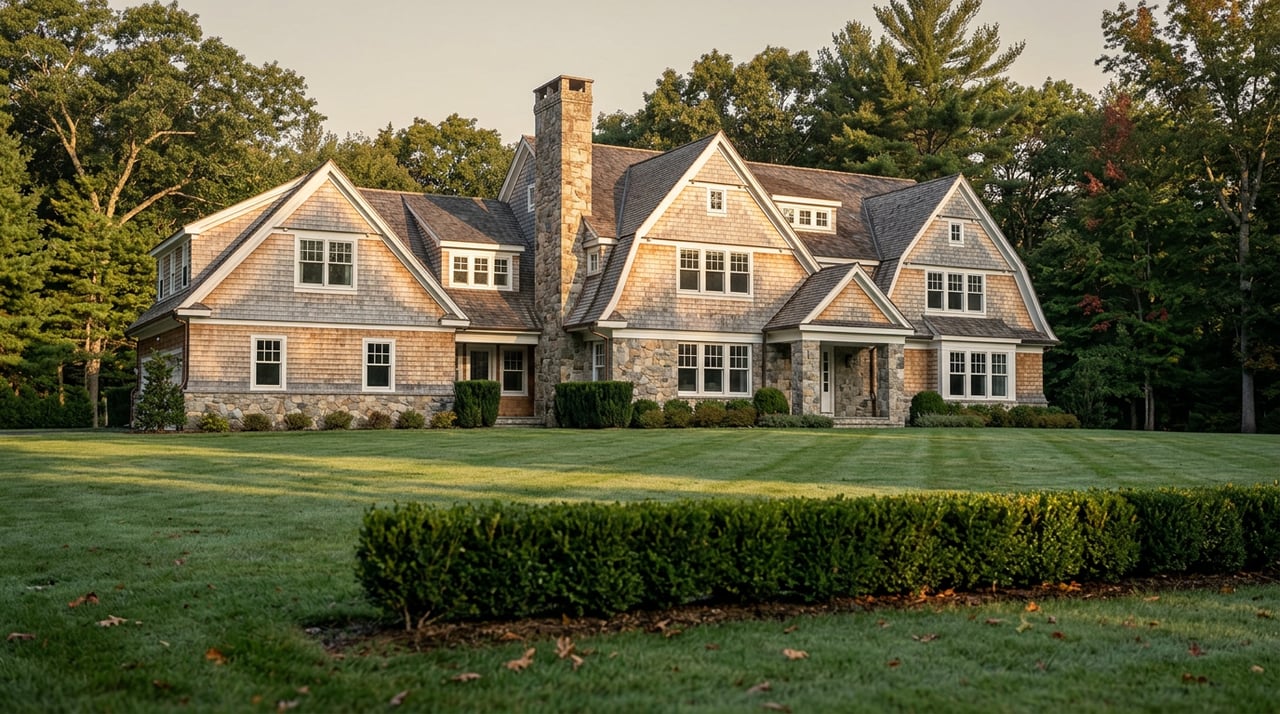
Backcountry Greenwich's Slow Market Has Nothing To Do With Hartford (Yet)
September 3, 2026
September 3, 2026
On June 10, in the parish hall of Christ Church Greenwich, Margarita Alban stood in front of a room of retirees who follow local real estate values with "the intensity of a high-stakes poker game." Alban has chaired the Greenwich Planning and Zoning Commission since 2018, and she had come to the Retired Men's Association to explain a new state housing law, the November 2025 special session act known in Hartford as Public Act 25-1 or HB 8002, that begins implementation in Greenwich on July 1, 2026, and continues through 2029. The room wanted to know what it meant for the town's character. Days later, the Greenwich Sentinel reported that one state legislator had flagged a more aggressive proposal already circulating in Hartford that would cap residential lot sizes at 5,000 square feet, a number so far from Backcountry's four-acre minimum that it would functionally erase the zoning that defines the neighborhood.
If you're comparing Backcountry Greenwich to other large-lot options in Fairfield County right now, that story is worth knowing. But it is not the reason Backcountry homes are currently sitting on the market two to three times longer than waterfront Greenwich and selling further below asking. That gap has a simpler, more immediate explanation, and understanding the difference between the two changes how you should read the negotiating room you're seeing today.
Over the past year, Old Greenwich and Cos Cob both averaged under 40 days on market with sale-to-list ratios above 103 percent, meaning buyers in those neighborhoods were routinely paying over asking. Back Country and North Parkway told a different story over the same stretch: 105 to 120 days on market, with sale-to-list ratios below 97 percent, meaning buyers were closing below list price as a matter of course, not exception.
| Market segment | Avg. days on market | Sale-to-list ratio |
|---|---|---|
| Old Greenwich & Cos Cob (trailing year) | Under 40 days | Above 103% |
| Back Country & North Parkway (trailing year) | 105-120 days | Below 97% |
| Town of Greenwich overall (July 2026) | 30 days | 106.3% |
Backcountry isn't just slower than the coastal neighborhoods. It's slower than the town's own average, in a market where the average itself is fast. That's the part a median price can't show you: the town-wide numbers describe a seller's market, and Backcountry, sitting inside that same town, behaves like something closer to a buyer's market.
Here's the detail that rules out a simple demand story. Over the past year, Backcountry's median sale price ran near $4.8 million, up roughly 35 percent year over year. Prices climbing while days on market stretch out isn't what softening demand looks like. It's what a thin market looks like: there are not many four-acre-plus estates trading in any given quarter, each one is priced against a handful of true comparables rather than a deep pool of recent sales, and the buyer who wants exactly that combination of acreage, privacy, and architecture has to wait for the right property to surface. Slow and expensive are not contradictory in a market this specific. They're the same fact seen from two sides.
The new state law Alban addressed in June, Public Act 25-1, works by requiring towns to submit housing growth plans and assigning them targets, with towns earning moratorium credit toward relief from the state's 8-30g affordable-housing litigation only if they streamline review for what the law calls "missing middle" housing. That streamlined review applies to areas zoned commercial or mixed-use. It does not touch RA-4 or RAC-4, the zoning designations that cover most of Backcountry.
You can see where the pressure is actually landing by looking at where Greenwich is putting its own effort. State Representative Hector Arzeno has been working to secure Connecticut Housing Finance Authority financing for the Vinci project at McKinney Terrace, a step toward the town's eventual redevelopment of Quarry Knoll. That single project could add roughly 250 units, moving Greenwich meaningfully toward its state-assigned affordable housing target, a target that under the new law could rise as high as 20 percent of occupied units. That's the growth the state is asking for, and it's being planned for downtown-adjacent parcels, not four-acre lots north of the Merritt Parkway.
The 5,000-square-foot lot cap that circulated in Hartford this year is a different animal entirely, and it's the one worth watching if you're thinking about Backcountry as a long-term hold rather than a five-year purchase. State Representative Tina Courpas, who represents the western part of town, told the RMA audience that more aggressive bills remain "in the wings." A mandate at that scale would apply statewide and would make Backcountry's four-acre minimum unenforceable as written. It has not become law. Alban's own approach, by her account, has been to try to accommodate the state's density targets while preserving what she calls the "human proportion" of the town, which suggests the commission sees a difference between adding units near the train station and rezoning the backcountry outright.
None of that guarantees anything about future sessions. But it does mean the political risk to Backcountry's zoning is a longer-dated variable, not a live cause of this year's slow absorption. Treat the two as separate questions: one about what's happening at the closing table now, and one about what the neighborhood's exclusivity might be worth to hold over a decade.
If you've already toured waterfront Old Greenwich and watched a well-priced house draw multiple offers inside three weeks, Backcountry's pace can feel like a red flag. It isn't one. It's the natural rhythm of a market where the buyer pool for any single estate is small by design, four-acre zoning limits how many parcels exist at all, and a property's true comparables might be two or three sales a year rather than two or three a month. Sale-to-list ratio and days on market tell you more about where you actually have room to negotiate than the median price does, and in Backcountry those two numbers are currently telling buyers something coastal Greenwich isn't: there's real room here, and it isn't a sign the neighborhood is losing value, it's a sign the neighborhood was never built to move fast.
A few things worth confirming before you write an offer on a Backcountry property:
Backcountry's appeal was never about speed. It's acreage, privacy, and a kind of architectural scale that coastal Greenwich doesn't have room for. The current market data confirms that trade-off rather than complicating it: buyers who want what only Backcountry offers are willing to wait for it, and sellers who understand that are pricing to the handful of buyers who will actually show up, not to a crowd that isn't coming.
If you're weighing a four-acre property against something closer to the water or the train, the numbers alone won't tell you which trade-off fits your life. That's a conversation worth having before you're comparing listings against a deadline.
Brid Mortamais works with buyers across Greenwich's very different sub-markets, from waterfront Old Greenwich to the acreage north of the Merritt Parkway, and can walk you through what today's negotiating room actually means for a specific property. Let's Connect. Schedule a personalized consultation.
Stay up to date on the latest real estate trends.
Brid is a full-time agent with a deep understanding of the local market and provides exceptional service for each of her clients whether they are renting, buying, or selling. She handles every aspect of each real estate transaction, guaranteeing her buyers and sellers the highest level of honesty, attention, and discretion.